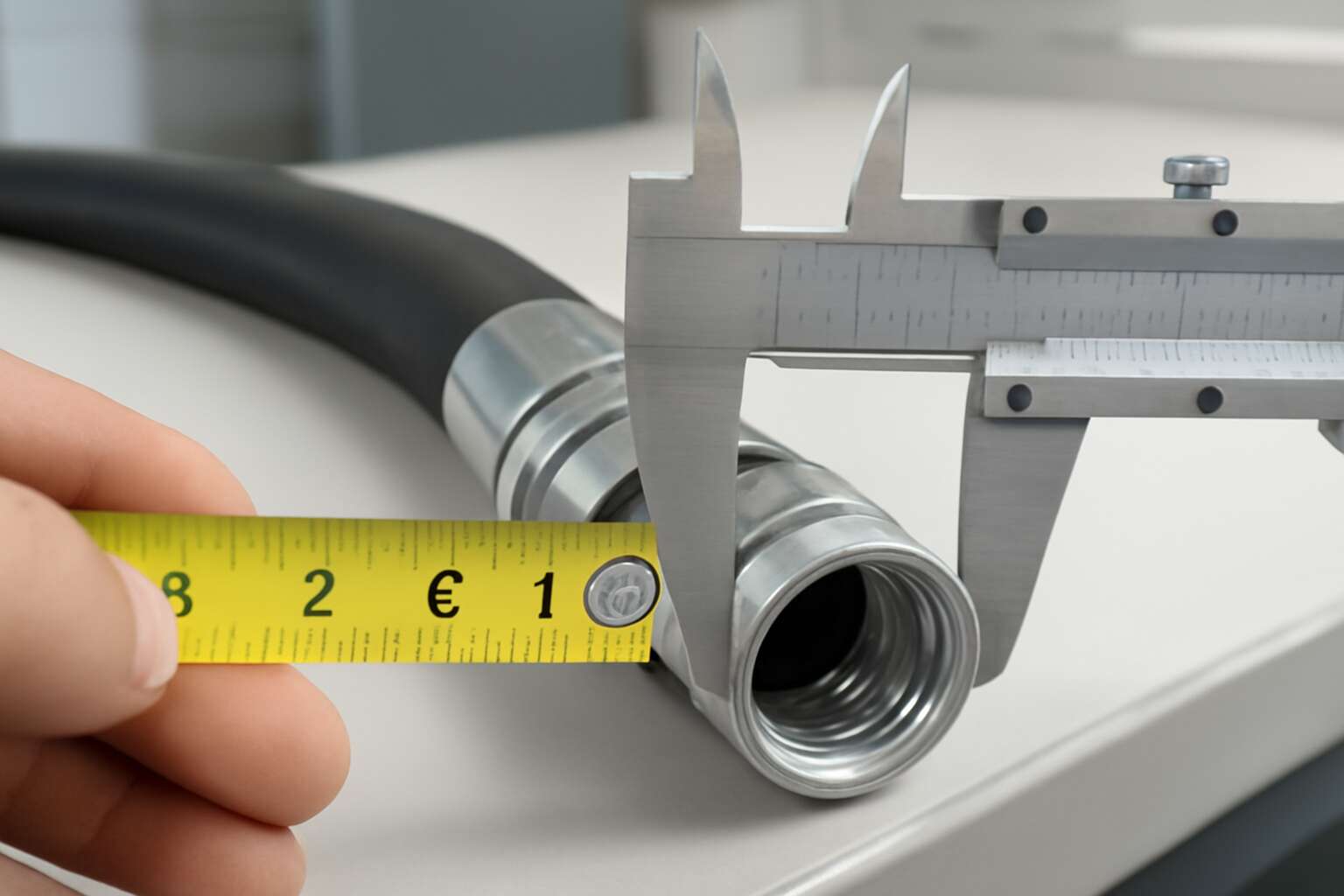
Hydraulic hose measurement basics
Identify hose type and series
In South Africa’s busiest workshop floors, precision matters more than horsepower! Mis-sized hydraulic hoses contribute to downtime worth thousands per week in many plants.
Hydraulic hose measurement basics begin with identifying hose type and series. Look for markings on the cover that reveal the code, size, and series—think R2AT or 4SP. For those wondering how to measure hydraulic hose, this first check clears the path toward proper compatibility and performance.
- Hose type and series identifiers on the cover
- Outer diameter (OD) and tolerance as a pairing signal
- End fittings and compatibility with the system’s pressure curve
With these cues, technicians build a mental map of a hose’s role in a circuit—where flexibility, strength, and seal integrity converge in a single, crucial component.
Know the common measurement standards
On South Africa’s busiest workshop floors, downtime feels personal—shouts in the yard and the clock ticking louder than the diesel. A mis-sized hose can quietly derail a production line, costing thousands every week. Understanding how to measure hydraulic hose accurately starts with the basics and those quiet figures that keep a plant running.
- Outer diameter (OD) and tolerance as a pairing signal
- Nominal size vs actual size and how it affects fit
- Consistency in units (inches or millimetres) across suppliers
These cues help technicians read a hose’s role in a circuit—where flexibility, strength, and seal integrity converge, quietly supporting a reliable flow. I’ve seen the difference precise measurements make when a system hums instead of groans.
Prepare your tools for measurement
On South Africa’s busiest workshop floors, downtime is a loud spectator. A misread hose size can stall a line and squeeze margins tighter than a drum. “A good measurement is cheaper than a rushed repair,” a veteran fitter likes to remind the team.
Measurement basics sit at the intersection of fit, flow, and reliability. It’s less about guesswork and more about reading the hose’s intended footprint—how much space it should occupy, how much leeway the maker allows, and what units the supplier favors.
Tools and techniques matter, but consistency matters more: use the same units across suppliers, and keep the tolerances in mind when comparing spec sheets. A calm, methodical approach reduces surprises when the hydraulic system hums rather than groans.
Understanding how to measure hydraulic hose helps keep the plant moving with confidence, rather than chasing downtime and rework.
Recordkeeping and labeling guidelines
South Africa’s busiest workshop floors remind us that a single misread hose size can stall a line and swallow margins. A veteran fitter often says, “A good measurement is cheaper than a rushed repair.” That wisdom anchors our approach to measurement with patience and a calm, precise heartbeat.
Recordkeeping turns measurement into a durable asset. Each footprint deserves a readable tag, date, and supplier reference. Labels must endure heat and oil on the shop floor.
- Durable tagging material resistant to oil and heat
- Clear print of part number, date, and operator initials
- Centralized log for easy traceability
This is how to measure hydraulic hose, a phrase that anchors practice to purpose. When the habit is right, records speak for themselves and the plant hums with quiet confidence across South Africa’s industries.
Measuring inner diameter and outer diameter
Measuring inside diameter with calipers
Measuring inner diameter and outer diameter is more than a number on a ruler; it defines fit and safety. The inside diameter is the bore that fluid travels through, while the outside diameter traces the hose’s shielded skin. For those exploring how to measure hydraulic hose, start with a calm eye: read ID and OD with a tool, note your units, and compare against manufacturer tolerances. A small deviation can ripple through the system, affecting fit and endurance.
Measuring inside diameter with calipers reveals the hidden radius of possibility. Calipers skim the bore with their internal jaws, giving a read that travels along the scale. Take a few readings across the length to catch eccentricity, then log a consistent figure in your records. In South Africa, these measurements travel through hydraulic networks with the same care you give your gear—precision, reliability, and a touch of magic.
Measuring outside diameter with calipers or ruler
In hydraulic systems, a half-millimetre variance can ripple into leaks, fatigue, and downtime. This is part of how to measure hydraulic hose, a discipline that marries geometry with foresight.
Measuring the outer diameter with calipers or a ruler sets the boundary of the hose’s shielded skin—the enclosure that keeps pressure contained and contaminants out. The bore remains the fluid’s path, linking fit to endurance in a quiet, invisible handshake. We know the outer diameter tells a full story of how well the hose will endure under load.
In South Africa, technicians carry these measurements through complex networks with care and pride. The geometry here echoes reliability and safety, a reminder that every diameter resonates beyond the hose itself.
Understanding wall thickness and tolerances
Even a half-millimetre slip in diameter can ripple through a hydraulic system, spilling downtime and money. Measuring inner diameter and outer diameter is not just geometry. It’s a balance between containment and flexibility, where wall thickness and tolerances decide how the hose will endure under pressure. In South Africa’s workshops, this precision carries a quiet, stubborn pride—every number quietly speaks to safety and reliability.
Think of the core factors as a compact quartet.
- Inner diameter
- Outer diameter
- Wall thickness
- Tolerances
Together, they frame how to measure hydraulic hose in practice; the exact figures guide fit and longevity without drifting into guesswork.
In our South African networks, precision translates to uptime.
Special cases for reinforced hoses
In South Africa’s workshops, 80% of hydraulic downtime starts with a diameter mismatch. The inner diameter tells you what fits; the outer diameter, with wall thickness, tells you how the hose behaves under pressure. This is at the heart of how to measure hydraulic hose.
Reinforced hoses add a twist. The braid or spiral reinforcement doesn’t just add strength—it shifts the true outer envelope, sometimes more than you expect from the label. That means OD can vary with pressure, bending, and temperature, so measurements must account for those quirks rather than rely on nominal numbers alone.
- Reinforcement adds to outer diameter beyond nominal ID
- Braided vs. spiral layouts affect tolerance and burst resistance
- Supplier tolerances set the acceptable range for fit
In SA workshops, treating these figures as living data keeps uptime high and leaks low.
Measuring hose length and bend radius
How to measure hose length accurately
In South Africa’s workshops, up to 65% of hydraulic hose failures start with a misjudged length. Measuring hose length and bend radius isn’t just about a snug fit—it guards uptime and safety. Understanding how to measure hydraulic hose begins with centerline length and the path the hose must trace, not straight-line distance. Route and fittings add hidden inches that matter.
- Centerline length versus overall length considerations
- Routing and fittings that alter effective length
- Manufacturer tolerances and hose standards
Bend radius determines sag, kink risk, and wear life. A generous bend radius keeps the system smoother and quieter under load. When planning, these concepts shape a reliable hose run without surprises.
Assessing minimum bend radius
In South Africa’s workshops, up to 65% of hydraulic hose failures start with a misjudged length. Measuring hose length and bend radius isn’t just a snug-fit exercise—it guards uptime and safety. Understanding how to measure hydraulic hose begins with centerline length and the path the hose must trace, not straight-line distance. Route and fittings add hidden inches that matter.
Centerline length and overall length aren’t the same once routing is factored in, since bends and brackets steal inches. The route and fittings subtly alter effective length, while manufacturer tolerances and hose standards set the perimeters we must respect on the shop floor.
Bend radius determines sag, kink risk, and wear life. A generous bend radius keeps the system smoother and quieter under load. When contemplating how to measure hydraulic hose, these elements guide a run that performs reliably while avoiding surprises.
Using markers and tape measures
In SA workshops, downtime costs money. Up to 65% of hydraulic hose failures start with a misjudged length, and neglecting bend radius only compounds the risk. Measuring hose length and bend radius isn’t a guesswork exercise—it guards uptime, reduces wear, and protects safety. Centerline length matters, but the route and fittings you pass add inches the tape won’t reveal if you skip them.
To capture the true length, mark the route and read along the centerline with a tape. If you’re wondering how to measure hydraulic hose, markers trace the route and a tape measures the path around bends. Use these simple aids to keep the run honest and predictable, so brackets and clamps don’t bite back.
- Place markers at key bend points to trace the path
- Extend the tape along the hose centerline, following the route
- Record total length and note any deviations caused by fittings
Consider extensions and fittings impact
South African workshops know downtime costs money, and up to 65% of hydraulic hose failures begin with a misjudged length. Bend radius left unchecked only deepens the risk. If you’re wondering how to measure hydraulic hose, the answer lies in tracing the route and reading along the centerline—the tape reveals the true course, including inches added by extensions and fittings.
Markers become witnesses to the truth; a path traced and read along the hose centerline keeps the run honest. I track the route, note deviations caused by fittings, and hold the long view—reliability, not guesswork, is the reward.
- extensions
- fittings
- route deviations
Documenting length discrepancies
Downtime costs in a South African workshop bite hard; up to 65% of hydraulic hose failures begin with a misjudged length. If you’re curious how to measure hydraulic hose, trace the route along the centerline and let the tape tell the truth. A plain ruler misses the hidden bends, and the bend radius remains unseen; the inches added by extensions and fittings reveal themselves only when the path is read in its true arc.
Document length discrepancies with quiet notes: the measured length whispers back, deviations caused by fittings become visible, and the run’s true silhouette is compared against the plan in a ledger of memory. Markers stand as witnesses; the journey is kept honest in ink and time.
- the tape speaks in inches and arcs
- extensions and fittings cast shifting shadows
- the route’s truth rests in measured memory
Verifying compatibility with fittings and standards
Matching hose ID and OD to standard fittings
In the hydraulic world, compatibility is the unsung hero. A hose that fits on paper but leaks on site is a catastrophe no one wants—downtime and a coffee-fueled meltdown included. Verifying compatibility with fittings and standards saves you from both.
To verify compatibility with fittings and standards, confirm that the hose ID and OD align with standard fittings used in your line, especially in South Africa where local standards bite hard. If you’re wondering how to measure hydraulic hose, start with the manufacturer’s data and a quick visual of the hose markings—that’s where the truth likes to lurk.
- Check that fittings adhere to common standards (SAE, ISO) and local SA supplier specs
- Ensure hose markings specify size, rating, and compatible couplings
- Cross-check with the assembly or flange style to avoid eccentric fits
When these checks line up, the system hums like a well-tuned diesel.
Interchangeability and manufacturer specs
Compatibility is the quiet engine behind reliability. A hose that fits on paper but leaks on site is a catastrophe—downtime, costly repairs, and a coffee-fueled meltdown in the workshop. Verifying compatibility with fittings and standards keeps the system humming and your schedule intact.
Start by confirming that hose ID and OD align with the standard fittings used in your line, with extra care for SA standards. Verify that fittings adhere to SAE, ISO, and local SA supplier specs. Hose markings should specify size, rating, and compatible couplings; cross-check with the assembly or flange style to avoid eccentric fits.
- SAE and ISO compatibility
- Local SA supplier specifications
- Manufacturer-approved couplings
Interchangeability and manufacturer specs act as the safety rails. If you’re wondering how to measure hydraulic hose to confirm compatibility, start with the manufacturer data and the hose markings—that’s where the truth lurks. When these signals line up, the system runs smoothly, without drama.
Checking for wear, corrosion, and damage indicators
A quiet engine behind reliability runs on compatibility. In South Africa’s workshops, a single mismatched fitting can stall a line and spike costs. If you’re wondering how to measure hydraulic hose for compatibility, start with the manufacturer data and hose markings—that’s where the truth lurks.
Verify fit by aligning hose ID and OD with standard fittings used in your line, with extra care for SA standards. SAE, ISO, and local SA supplier specs should guide every connection.
- SAE and ISO compatibility
- Local SA supplier specifications
- Manufacturer-approved couplings
Interchangeability and manufacturer specs act as safety rails. Beyond fit, check for wear, corrosion, and damage indicators that threaten integrity.
- Cracks, cuts, or gouges on the jacket
- Flat spots or bulges along the hose
- Corrosion at fittings or ferrules
When these signals align with markings and standards, the system runs smoothly.
Using part numbers and traceability
“Mismatched fittings turn trust into trouble,” the foreman mutters as the workshop hum fades. When you ask how to measure hydraulic hose for compatibility, follow the lineage: part numbers, traceability marks, and the manufacturer catalog. Don’t guess—align each connection with SAE, ISO, and SA supplier specs, and invite reliability back into the line.
Using part numbers and traceability isn’t a habit; it’s a discipline that keeps the line honest. Track each hose to its origin, verify stamps on the jacket, and cross-check with current manufacturer updates. The system shines when couplings are chosen by their pedigree and supported by official data.
- Part numbers and batch codes
- Traceability documents and lot histories
- Manufacturer-approved couplings and verified fittings
In SA workshops, standards set the tempo. SAE, ISO, and local supplier specs should guide every connection, ensuring the chain from hose to line remains unbroken.



0 Comments